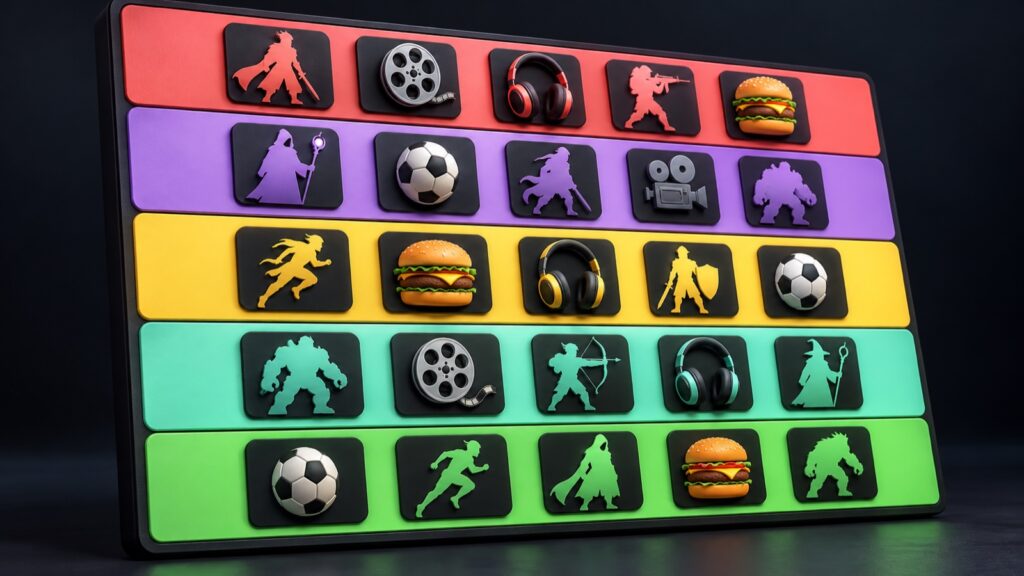
A tier list is a way to sort a group of things into ranked levels, or tiers. Instead of giving every item a unique position from first to last, you place items of similar quality, strength, or personal appeal in the same row. The strongest or most favored choices go near the top; the weakest or least favored go near the bottom.
You might rank video game characters by how effective they are in competitive play, movies by how much you enjoyed them, or fast-food restaurants by your own taste. The format stays the same, but the meaning of each tier depends on the question you are asking.
How do tier list rankings work?
A familiar layout uses S, A, B, C, and D from top to bottom. These labels are a convention, not a rule:
- S tier: Exceptional choices that stand above the rest.
- A tier: Excellent choices, just below the very top.
- B tier: Good or solid choices.
- C tier: Average, situational, or less appealing choices.
- D tier: The weakest choices in this particular ranking.
Some lists add an F tier, split a tier into plus and minus levels, or replace letters with labels such as “Favorites,” “Good,” and “Not for me.” There is no universal scoring system. A D-tier movie on a list of great films could still be worth watching; it is simply lower relative to the other films on that list.
Why use tiers instead of a numbered ranking?
Numbered rankings force a decision between every neighboring pair. A tier list lets you say that several items belong in roughly the same group. That makes it easier to compare a large collection and easier for readers to understand your overall opinion at a glance.
Tier lists are especially useful when exact positions would imply more certainty than you really have. If two characters are similarly strong, putting both in A tier may be more honest than insisting one is number 7 and the other number 8.
Are tier lists objective or subjective?
They can be either, or a mix of both. A competitive gaming list might use tournament results, matchups, and the current game version. A “favorite snacks” list is personal by design. Even evidence-based lists involve choices about which evidence matters most, so a good tier list explains its criteria.
Before making one, decide what “best” means. Is it power, popularity, value, design, nostalgia, or your personal enjoyment? Keep that standard consistent as you place items.
How to make a tier list
- Choose a topic and gather the items you want to compare.
- Set a clear criterion for the ranking.
- Name your tiers so their meaning is obvious.
- Place the easy choices first, then compare the difficult ones.
- Review the whole chart to make sure similar items are treated consistently.
- Share your reasoning if you want others to discuss your picks.
You can start with a ready-made template or create a tier list from scratch. For a step-by-step walkthrough, read our guide to making a tier list.
The short answer
A tier list is a visual ranking that groups comparable items into levels. It is most useful when you state what you are ranking and why, then let the tiers show the broad differences without pretending every item needs an exact numerical score.